





Wholesale Decorative Paint Supply and B2B Solutions
How do you choose a supplier for wholesale decorative paint? A B2B guide covering batch consistency, MOQ, documentation, private label production and logistics.
In wholesale paint purchasing, price is the most visible line on the list but rarely the most expensive one. The real cost appears six months later, when the same colour no longer matches, when a technical document is requested and the file cannot be found, or when the product runs out of stock in the middle of a project. In this article we explain what dealers, project companies and importers should look at when choosing a decorative paint supplier, and how corporate solutions are structured.
Key Takeaways
- In wholesale purchasing the decisive criterion is not the unit price but supply continuity and colour consistency between batches.
- Technical documentation support (TDS and MSDS) is not a detail; it is a mandatory part of project, tender and customs files.
- Private label production and custom labelling offer a ready-made manufacturing infrastructure to distributors who want to build their own brand.
- The minimum order quantity varies by product group and destination country; container planning must be done from the outset.
- With decorative products, selling works together with application training and colour chart support; a texture product sold without training comes back as a complaint.
Where Does the Real Cost Arise in Wholesale Purchasing?
The cost of a can of paint does not end with its shelf price. For a distributor or a project company, the items that determine the total cost are the following:
- Batch consistency: The same code producing the same tone in different batches. When it does not match, the price is repainting a finished wall.
- Stock continuity: A product that runs out in the middle of a project turns into a work stoppage and delay penalties.
- Consumption: A product with low opacity looks cheap but is consumed more per m² and requires more labour.
- Technical support: Not getting a fast answer to a problem that arises on site slows down both the job and the customer relationship.
- Documentation: A missing document at the tender or customs stage puts the order itself at risk.
Supplier Evaluation Checklist
| Topic | Question to ask | Why it matters |
|---|---|---|
| Production infrastructure | Where is production carried out, what is the capacity? | The source of supply continuity |
| Colour system | Can the colour be reproduced by code? | Consistency between batches |
| Product range | Are there interior, exterior, effect and synthetic groups? | A complete solution from a single supplier |
| Documentation | In which languages are the TDS and MSDS available? | Tender and customs files |
| Packaging | Which sizes, how is palletising handled? | Warehouse and transport efficiency |
| Private label production | Are custom formulas and labels possible? | The chance to build your own brand |
| Field support | Is application training provided? | Continuity of sales in decorative products |
| Logistics | How is the container plan set up? | Delivery time and freight cost |
Why Does Production Infrastructure Come First?
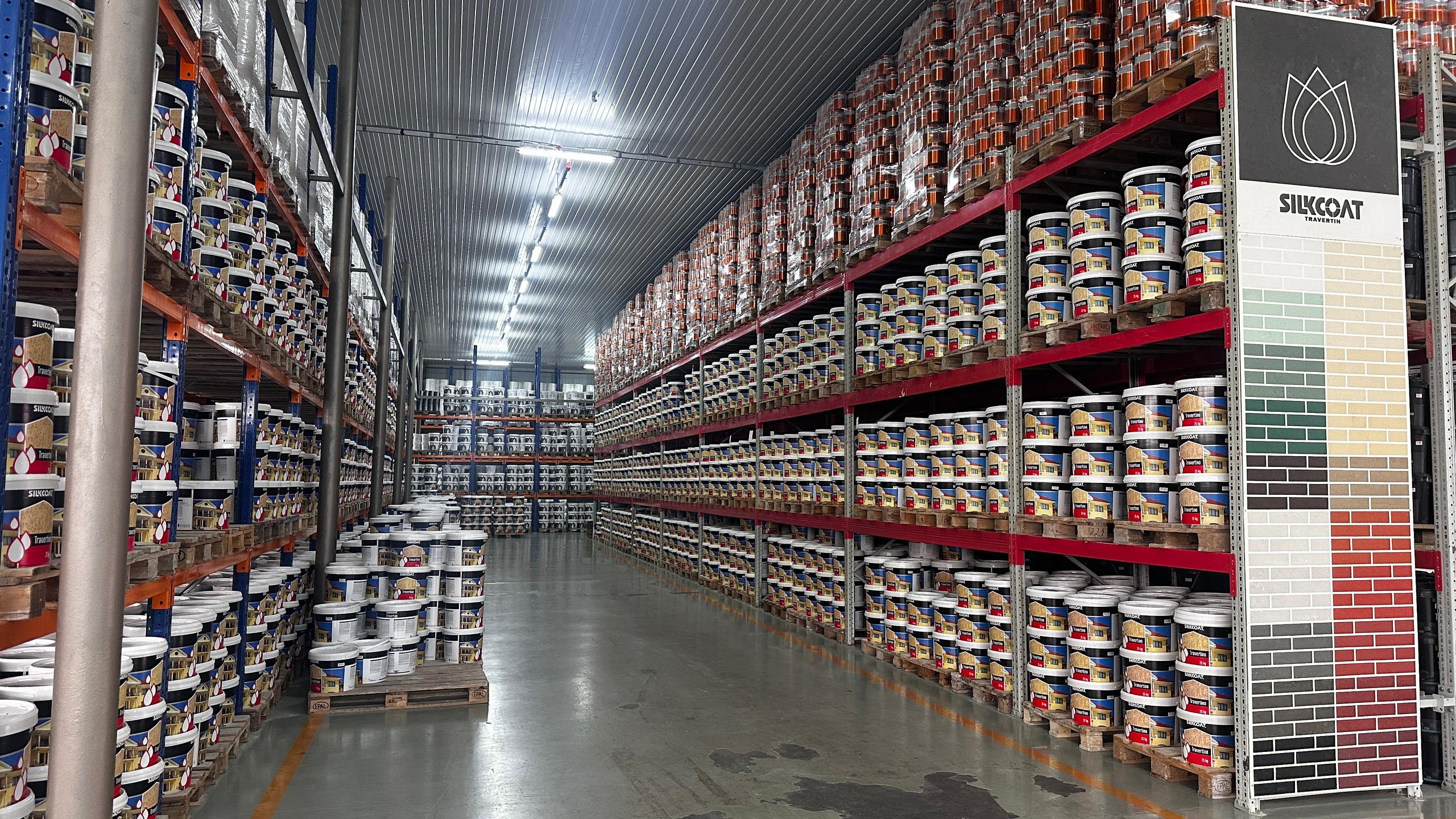
In decorative paint, supply continuity is a direct result of production capacity and geographical spread. Silkcoat is a manufacturer founded in 1993 and part of the Çolakoğlu Group, which has been operating since 1961; it works across 5 continents with a total of 13 production facilities in Türkiye, Uzbekistan, Tajikistan, Mauritania, Ghana, Algeria, Nigeria, Tanzania, Iraq, Ethiopia, Malaysia, Pakistan and Guinea, and exports to 83 countries.
In practical terms for a distributor, this structure means the following: if there is production in your region, delivery times get shorter, freight costs fall and the products arrive formulated for local climate conditions. On the Factories page you can see how the facilities are distributed by country, and on the export markets page you can review the markets that are being actively developed.
Product Range: A Complete Solution from a Single Supplier
For a dealer, a narrow product range means going to a second and a third supplier for every project. This complicates both stock management and the customer relationship. The Products section is gathered under six main groups: interior paints and primers, exterior paints and primers, effect paints, silk plasters, synthetic paints and spray paints. In a housing project, having the primer, the interior topcoat, the exterior coating and the joinery paint come from the same supplier simplifies both technical compatibility and order management.
On the decorative side, texture products are also decisive: the effect paints and silk plasters groups are the products that set you apart from competitors selling standard paint, and they are usually sold with higher added value.
Private Label Production and Custom Labelling
For distributors who want to sell under their own brand, private label production is the way to access a manufacturing infrastructure without building a factory from scratch. In this model, product formulation, production and packaging are handled on the manufacturer's side; the brand, the label and the marketing belong to the distributor. Requests for formulations specific to a project or a market are evaluated within the same process — for example, tropical climates may call for different exterior solutions than arid and dusty regions.
Private label production, custom formulation and technical support are defined on the services page. If this route is chosen, the sample-approval-production cycle must be written into the schedule from the start; the packaging design and the label language should also be settled at this stage.
Orders, MOQ and Logistics
The minimum order quantity is not a single number; it varies by product group and destination country. In container-based export orders, the real gain comes from setting the loading plan up correctly: balancing heavy and light products, the pallet layout and choosing packaging sizes according to the container volume noticeably affect the freight cost.
On the delivery time side, managing expectations matters: domestic orders are delivered within a few days depending on stock, while export orders take a few weeks depending on container planning and the customs process. The regional warehouse network plays a direct role in shortening this period.
After the Sale: Documentation, Colour Charts and Training
With decorative products, the sale does not end when the can is delivered. Three support items directly make the dealer's job easier:
- Technical documentation: The technical data sheet and the safety data sheet of every product can be downloaded from the TDS archive. Tender files, project specifications and customs paperwork cannot be completed without these documents.
- Colour chart and catalogue: The colour and texture discussion held with the customer is concluded far more quickly with printed colour charts and catalogue support.
- Application training: With products such as effect paint and silk plaster, the result is in the applicator's hands. A texture product sold without training will most likely come back as a complaint. Training the applicator teams in your region increases sales volume permanently.
Common Mistakes
- Looking only at the unit price and not taking consumption and opacity into account.
- Working with a supplier that has no colour code system and noticing the tone difference between batches only later.
- Requesting technical documents at the tender stage and losing time.
- Selling texture products without providing application training.
- Not choosing packaging sizes according to the container plan and shipping empty volume.
- Making the private label production decision at the end of the project schedule.
Stock Management and Seasonal Demand
Paint demand does not run flat throughout the year. The construction and renovation season concentrates in certain months depending on weather conditions; in exterior products this fluctuation is far more pronounced than in interior products. A dealer whose stock is not complete at the start of the season loses sales during the year's period of highest demand.
The method that works is to separate products by turnover rate. Fast-moving items such as primer and white interior paint are kept in stock continuously; coloured and decorative products are planned according to the project or the order. For decorative products, display and sample stock should be considered separately — the customer will not decide without touching the texture.
Shelf life is part of the plan as well. Products should be stored with the lid closed, in an environment that does not freeze and receives no direct sunlight; a first-in, first-out order should be applied in the warehouse. Keeping a record of batch numbers makes it easier to select the products going to the same project from a single batch.
Conclusion: You Are Choosing an Infrastructure, Not a Supplier
In wholesale decorative paint purchasing, the decision you make is not a product but the production, documentation, logistics and training infrastructure behind it. Evaluate batch consistency, the breadth of the product range, documentation support and the regional production and warehouse network; discuss price after these four topics.
A concrete next step: list the product groups that the market you sell in needs, match them through the catalogue, and send your dealership or project supply request through the form on the contact page. For details about the corporate structure you can look at the corporate page.
Before the unit price, batch consistency, stock continuity, consumption, technical documentation support and logistics should be evaluated. The same colour failing to match across batches, or stock running out in the middle of a project, creates a cost far above any price advantage.
First the product groups that the target market needs are identified, then the matching is done through the catalogue. Dealership and project supply requests are sent through the form on the contact page; the product range, volume and region are settled in that discussion.
The MOQ is not a single number; it varies by product group and destination country. In container-based export orders, the logistics team works with you to build the most efficient loading plan, balancing heavy and light products.
Formulation, production and packaging are handled on the manufacturer's side; the brand, the label and the marketing belong to the distributor. Requests for market-specific formulations are evaluated within the same process. Time must be set aside in the schedule for the sample, approval and production cycle.
The TDS defines how the product is to be applied and its technical performance, while the MSDS defines the rules for safe transport, storage and disposal. Tender files, project specifications and customs paperwork cannot be completed without these documents.
Domestic orders are delivered within a few days depending on stock. Export orders take a few weeks depending on container planning and the customs process; the regional warehouse network shortens this period.
Exports are made to 83 countries and operations are carried out across 5 continents with a total of 13 production facilities. The facilities outside Türkiye are located in Uzbekistan, Tajikistan, Mauritania, Ghana, Algeria, Nigeria, Tanzania, Iraq, Ethiopia, Malaysia, Pakistan and Guinea.
With decorative products such as effect paint and silk plaster, the result depends on the applicator's technique. For this reason, training the applicator teams in the region is an inseparable part of the sale; texture products sold without training usually come back as complaints.