



Marmarino Plus Application Guide: Marble Effect Layer by Layer
Marmorino application steps: surface prep, 2 spatula coats, a texture coat and trowel burnishing. Drying times and common mistakes, per silkcoat.com.
Short answer: Marmorino application is completed in four layers: Marmarino Plus is spread unthinned in two coats with a spatula over a prepared surface, a texture coat is built with irregular strokes once the second coat is dry, and the surface is finally burnished with a trowel. According to silkcoat.com, you wait at least 4 hours between coats, the product dries fully in 24 hours, and application should take place between +5°C and +35°C.
What is marmorino application and how many stages does it involve?
Marmorino application is the process of spreading lime-based Marmarino Plus layer by layer with a spatula and a trowel to create a velvety, marble-patterned surface on the wall. According to Silkcoat's instructions, the process has four stages: surface preparation, two base coats, a texture coat and burnishing.
Marmarino Plus, as silkcoat.com defines it, is a water-based, lime-based, marble-patterned decorative interior paint with a pure acrylic binder. The product comes ready to use and is not thinned, so a successful result depends not on a mixing ratio but on the condition of the substrate, the waiting time between coats and your hand movements. The base coats cover the surface and set the colour, the texture coat forms the skeleton of the pattern, and the final burnishing compresses that texture to bring out the marble look. Because each layer builds on the one before it, rushing into the second coat or applying the texture coat to a half-dry surface can spoil the pattern. We covered the product's general features in our article What is Marmarino Plus plaster; this guide focuses on application only.
What materials do you need for marmorino application?
For Marmarino Plus application, all you need is the product itself, a spatula, a trowel, filler and primer for surface preparation, and water for cleaning. Since the product is not thinned, no extra thinner is required.
Before you start, have the following ready:
- Marmarino Plus: according to silkcoat.com, it comes in 12 kg and 4 kg plastic tubs; its coverage is 4.5-5.5 m²/kg, i.e. 250-300 g/m².
- Spatula: the two base coats and the texture coat are applied with a spatula.
- Trowel: the final burnishing stage is done with a trowel.
- Surface materials: Silkcoat Akrilik Macun (acrylic filler) for uneven surfaces, and Silkcoat Universal Astar (universal primer) for smooth, previously painted surfaces.
- Sandpaper: to improve adhesion on very glossy or glassy surfaces.
To work out how much product your wall needs per square metre, you can use the table in our article how many m² does effect paint cover.
How do you prepare the surface before applying Marmarino Plus?
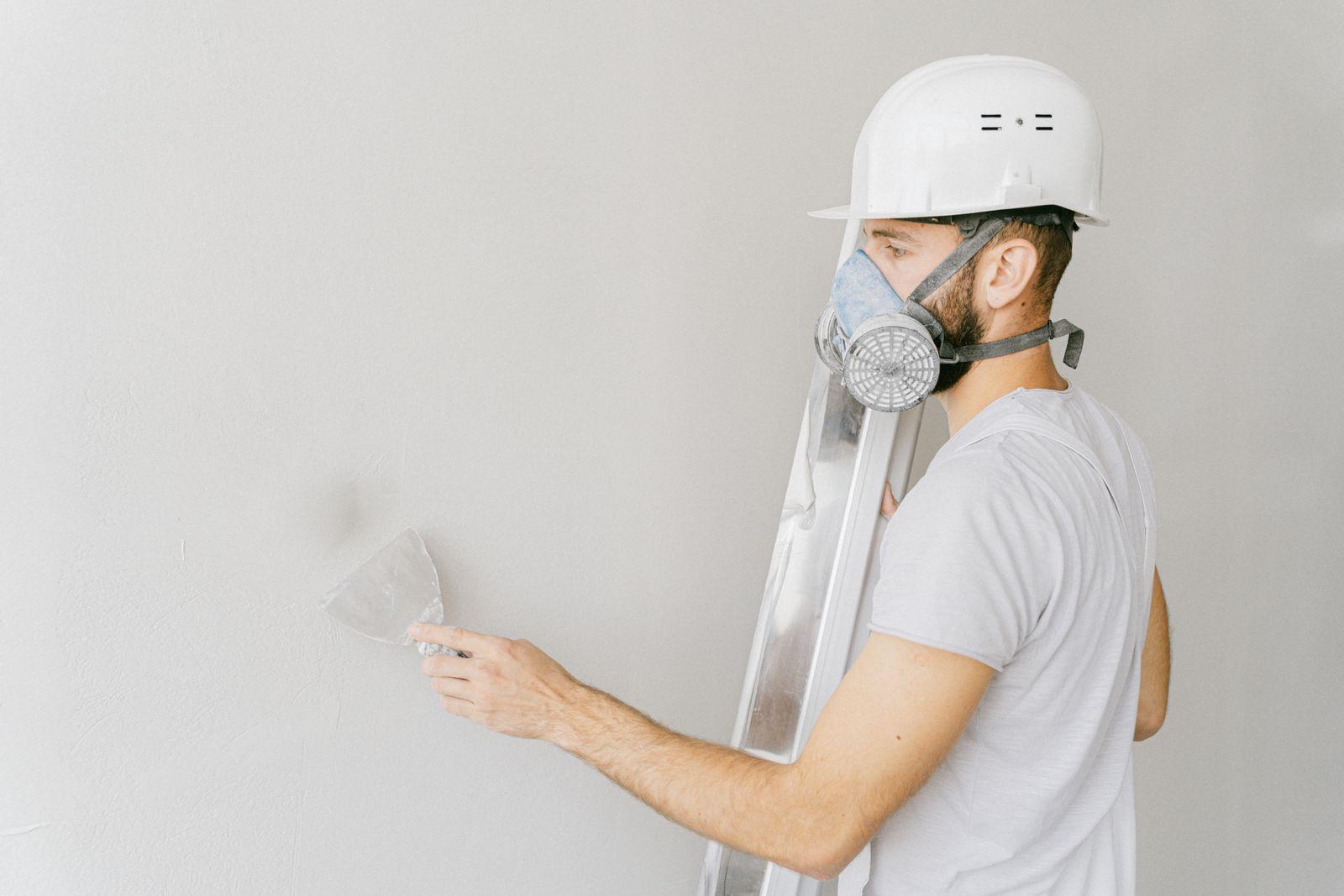
The surface to receive Marmarino Plus must be clean, dry and sound: grease, dirt and dust should be removed, flaking paint scraped off and very glossy surfaces sanded. According to silkcoat.com, after surface preparation the product can be applied to old painted surfaces, concrete, plaster, cement boards, wallpaper and glass-fibre textile surfaces.
The surface preparation instructions on the silkcoat.com page for Marmarito, which uses the same application method, follow this order:
- Remove grease, dirt and dust from the surface.
- Scrape off flaking and old paint.
- If the surface is uneven, level it with Silkcoat Akrilik Macun.
- Apply Silkcoat Universal Astar to smooth, previously painted surfaces.
- Sand very glossy or glassy surfaces.
Surface preparation is the most critical step for an even-looking marble pattern, because during burnishing, light from the side makes every imperfection in the substrate stand out. We explain primer choice in detail in our guide choosing a primer before effect paint.
How do you apply Marmarino Plus step by step?
After mixing, Marmarino Plus is applied unthinned in two coats with a spatula; once the second coat is dry, a texture coat is built, and finally the surface is burnished with a trowel. Depending on the weather, you wait at least 4 hours between coats.
According to Silkcoat's application instructions, the steps are:
- Mixing: stir the product thoroughly before use until it is completely uniform.
- First coat: spread Marmarino Plus onto the surface with a spatula, without thinning.
- Waiting: wait at least 4 hours, depending on the weather.
- Second coat: apply the product a second time with a spatula, again without thinning.
- Texture coat: once the second coat is dry, spread the product with a spatula in irregular diagonal and vertical-horizontal strokes to create a textured surface.
- Burnishing: press the trowel up and down and sideways, then burnish the whole surface with light circular movements.
- Cleaning: clean your tools with water after application.
According to silkcoat.com, different colour effects can be achieved. We show the general techniques for a marble pattern, with examples, in our article how to apply marble effect paint.
How long do Marmarino Plus coats take to dry?
According to the technical data on silkcoat.com, Marmarino Plus is touch-dry in 30-45 minutes, dust-free in 1-1.5 hours and fully dry in 24 hours; you should wait at least 4 hours between coats. These times make it easier to plan the application within a single day.
| Stage (silkcoat.com) | Time |
|---|---|
| Touch-dry | 30-45 minutes |
| Dust-free | 1-1.5 hours |
| Time between coats | At least 4 hours |
| Fully dry | 24 hours |
| Application temperature | Between +5°C and +35°C |
The waiting time depends on the weather; in cool, humid conditions the coats may take longer to dry. Being touch-dry is not enough for the next coat: silkcoat.com asks for at least 4 hours between coats.
How do you plan a marmorino application?
A marmorino application is planned around the minimum 4-hour wait between coats; if surface preparation is finished the day before, the base coats, texture coat and burnishing can be done in sequence the next day. Since the product dries fully in 24 hours, furniture placement and use of the wall should be scheduled around this time too.
A practical work plan might follow this order:
- Preparation day: clean the wall, level it with filler if needed and prime it; allow the filler and primer their own drying times as stated on their product pages.
- Application day, morning: mix Marmarino Plus and spread the first coat with a spatula.
- At least 4 hours later: apply the second coat.
- Once the second coat is dry: build the texture coat with irregular spatula strokes, then complete the burnishing with a trowel.
- The next 24 hours: let the surface dry fully; during this time it is best not to touch the wall or lean anything against it.
Take the weather into account when planning, too: according to silkcoat.com, ambient and surface temperature should stay between +5°C and +35°C during application and drying. In an unheated room in winter, or on a wall in direct sun in summer, you may fall outside this range, so choose the time of application accordingly. On large walls, keeping the area you work on in one go small makes it easier to give the texture coat and burnishing the same consistency.
What are the most common mistakes in marmorino application?
The most common mistakes in marmorino application are starting without preparing the substrate, cutting short the waiting time between coats, always working in the same direction in the texture coat and applying uneven pressure when burnishing. Most of these mistakes become visible in side light once the surface is dry.
The main points to watch are:
- Unprepared substrate: applying over a glossy surface without sanding it can weaken adhesion.
- Moving on too early: if the second coat or the texture coat goes on before the previous coat is dry, the pattern can be spoiled.
- One-directional strokes: spatula strokes repeated in the same direction in the texture coat can leave a streaky look instead of natural marble.
- Uneven burnishing: if the trowel touches the surface with varying pressure, it can create differences in sheen between parts of the wall.
To check the surface after application, see our article on checking effect paint for defects with raking light, and to fix problems, see effect paint application mistakes.
What safety points should you keep in mind when applying Marmarino Plus?
According to silkcoat.com, when working with Marmarino Plus you should avoid contact with eyes and skin, rinse with plenty of water in case of contact, store the product tightly closed out of the reach of children and never pour waste into the drains. The product is water-based, and the site describes it as harmless to human health and environmentally friendly.
For storage, silkcoat.com recommends keeping the product in its unopened packaging in a cool, clean, dry place away from direct sunlight; under these conditions its shelf life is at least 2 years. If you are curious about how its application differs from classic Venetian plaster, take a look at our article the difference between Marmarino Plus and Venetian plaster.
Conclusion
- Marmorino application is completed in four stages: surface preparation, 2 base coats with a spatula, a texture coat and trowel burnishing.
- Marmarino Plus is ready to use and is not thinned; according to silkcoat.com, its coverage is 4.5-5.5 m²/kg.
- Wait at least 4 hours between coats; the product is touch-dry in 30-45 minutes and fully dry in 24 hours.
- During application and drying, ambient and surface temperature should be between +5°C and +35°C.
- You can explore the product on the Marmarino Plus page and its alternative on the Marmarito page, or get in touch with us for application support.
According to Silkcoat's instructions, Marmarino Plus is applied unthinned in 2 coats with a spatula. Once the second coat is dry, a texture coat is built and the surface is burnished with a trowel.
According to silkcoat.com, you wait at least 4 hours between coats, depending on the weather. The product's full drying time is 24 hours.
The base coats and the texture coat are applied with a spatula, and the final burnishing is done with a trowel. Tools are cleaned with water after application.
According to silkcoat.com, ambient and surface temperature should be between +5°C and +35°C during application and drying.