



Travertine-Look Kitchen Backsplash
How do you create a travertine-look kitchen backsplash? Stone texture with Travertino and Arteco, Viabella over tiles, and key points to watch.
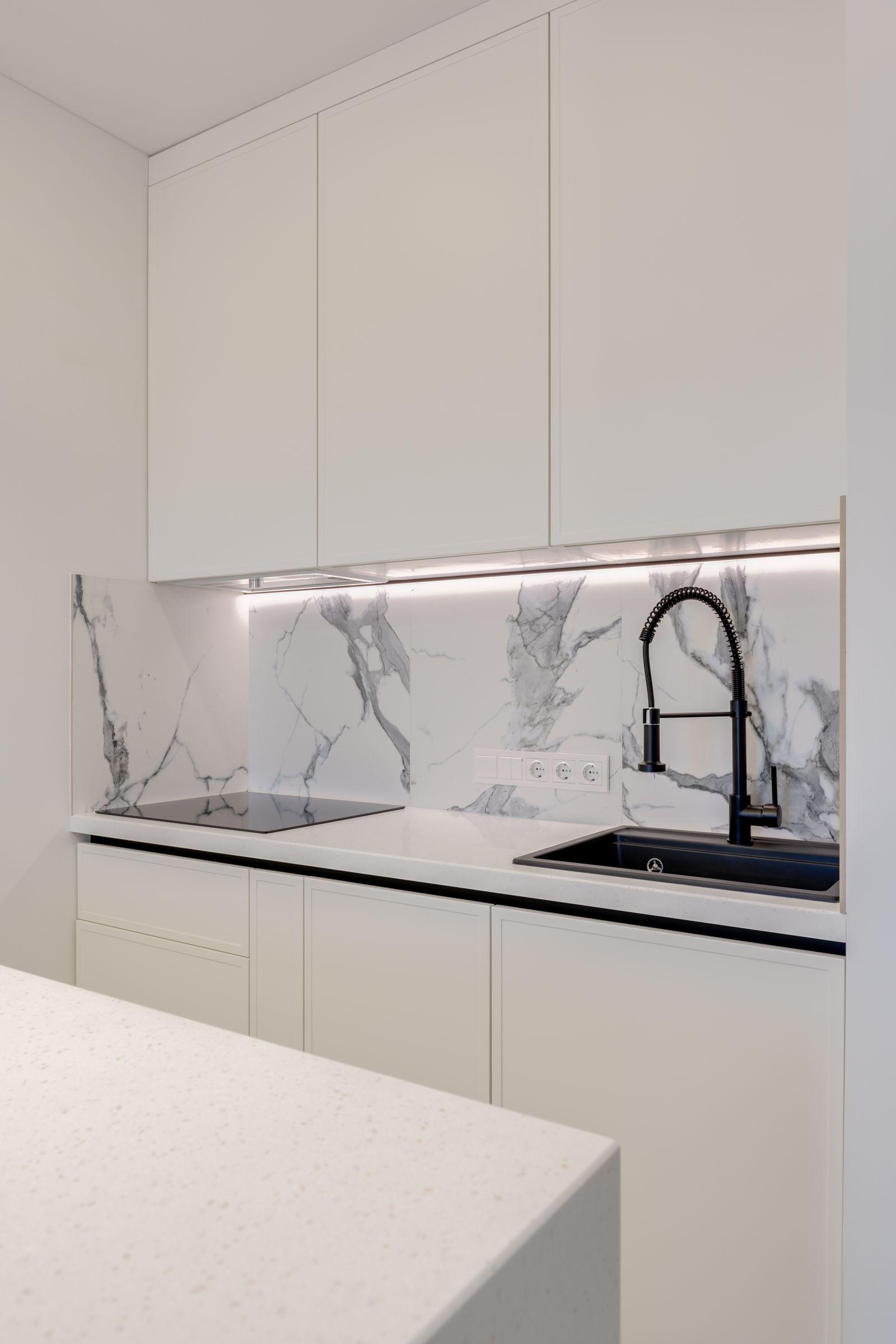
Short answer: A travertine-look kitchen backsplash wall covering can be created with Silkcoat's antique stone decorative paint Travertino and Arteco applied as the final coat; the result is a grooved, aged stone texture that resembles natural travertine. silkcoat.com describes Travertino for interior surfaces, but the product page gives no information on water, moisture or washability. For areas that take direct splashes of water and grease, such as behind the sink and the hob, the product should therefore be chosen in consultation with Silkcoat; if existing tiles need to be renewed, Viabella, whose page states its water resistance, is worth considering.
What is a kitchen backsplash wall covering?
A kitchen backsplash wall covering is a surface finish used to protect the strip of wall between the worktop and the wall cabinets while giving it a decorative look. This area is usually covered with ceramic, tiles, glass or stone; in recent years, decorative paints that offer the look of natural stone with a lighter application have also become a popular choice.
The backsplash is the most visible part of the kitchen and the part that gets dirty most often. During food preparation, splashes of water, grease and food concentrate here. That is why two questions are asked together when choosing a backsplash wall covering: does the covering give the desired look, and does it suit the cleaning needs of this area? A travertine look answers the first question convincingly; for the second, you need to check what the product pages say.
How do you get a travertine look on a kitchen backsplash?
According to silkcoat.com, the travertine look is achieved by applying Travertino, an acrylic copolymer cement-based antique stone decorative paint, in two coats with a trowel, opening grooves with the back of the trowel in the second coat, and finishing with Arteco as the final coat. The grooves recreate the veining of natural travertine, while Arteco adds colour variation and depth.
Travertino is described on silkcoat.com as a product that offers a stone look, promises an aged yet modern quality and allows different pattern applications. Because it is water-based, the page states that it is not harmful to human health or the environment. Arteco, used for the final coat, is an effect paint that gives the surface an aged effect. We compared the travertine effect with natural stone in terms of look, weight and cost in detail in our travertine effect paint article.
What are the technical values of Travertino?
According to silkcoat.com, Travertino's coverage is 1-1.5 m²/lt, i.e. 1500-2500 g/m²; the product comes ready to use, takes 1 day to hard-dry and is supplied in 15 kg and 25 kg plastic buckets. The table below brings together the values from the product page:
| Value (silkcoat.com) | Travertino |
|---|---|
| Composition | Acrylic copolymer cement-based, water-based |
| Coverage | 1-1.5 m²/lt, 1500-2500 g/m² |
| Density | 1.95±0.02 g/ml |
| Thinning | Ready to use; add 20-25% water for the first coat |
| Drying | Hard-dry in 1 day; first coat dries in 24 hours |
| Packaging | 25 kg and 15 kg plastic bucket |
| Storage | At least 2 years in unopened packaging |
| Application temperature | Between +5°C and +35°C |
A backsplash is usually a small area, so the amount of material needed is calculated by multiplying the measured square metres by the coverage value on the page. We explained the logic of product-based calculation in our how many m² does effect paint cover article.
What should you watch out for when applying Travertino to a backsplash?
The most important point when applying Travertino to a backsplash is that the product page gives no information on water, moisture, heat or washability; Silkcoat should be consulted for areas that take direct splashes, such as behind the sink and the hob. silkcoat.com describes Travertino for interior surfaces only and gives prepared surfaces such as concrete, plaster, rough plaster and cement board as examples.
Keep the following points in mind when planning:
- Location: Parts of the backsplash away from the sink and the hob, a coffee corner or walls facing the dining area are better starting points for a travertine effect.
- Substrate: According to silkcoat.com, Travertino is applied to prepared interior surfaces; the page gives no information about applying it over existing tiles.
- Drying: The product is cement-based and you wait 1 day between coats; the kitchen should not be used during this time and the surface should be protected.
- Heat: Since the product page gives no information on heat resistance, areas close to the hob should be assessed separately.
We went through, product by product, which effect paints are washable on kitchen walls and what the site says about moisture in our can effect paint be applied to a kitchen wall article.
How do you renew the tiles on a kitchen backsplash?
If there are existing tiles on the backsplash, according to silkcoat.com they can be renewed with Viabella, a multi-surface paint that can be applied to tiles, ceramic and porcelain. Viabella's page states that it has excellent water resistance and can be easily cleaned with a damp, soapy cloth.
Viabella does not create a travertine texture; it is used to turn tiles into a smooth, cleanable surface without removing them. According to the application rules on silkcoat.com, the product is applied in two coats, waiting at least 2 hours between coats. Treated surfaces should not be used for 1 day, and surfaces in contact with water for 2 days; water must not be allowed to pool during the first 7 days. For more details, see our Viabella multi-surface paint article.
Which Silkcoat product should you choose for a backsplash?
If a stone look is the priority, choose Travertino; if you want an easy-to-clean marble texture, choose Marmarino Plus or Marmarito; if you want to turn existing tiles into a highly water-resistant surface, choose Viabella. The table below compares the products based on the information on their silkcoat.com pages:
| Product | Look | Cleaning and water information on silkcoat.com | Surface applied to |
|---|---|---|---|
| Travertino + Arteco | Grooved, aged travertine stone | No information on the page | Prepared interior surfaces |
| Marmarino Plus | Lime-based marble pattern | Easy to clean thanks to its glassy surface | Interior surfaces |
| Marmarito | Velvety marble pattern | Easy to clean thanks to its glassy surface | Interior surfaces |
| Viabella | Smooth, renewed surface | Excellent water resistance, cleans with a soapy cloth | Tiles, ceramic, porcelain, wood and more |
The two approaches can also be combined: while the tiles around the sink and the hob are renewed with Viabella, a travertine look can be created with Travertino on the parts of the backsplash away from these areas or on the kitchen's accent wall.
How is Travertino applied to a kitchen backsplash?
According to the instructions on silkcoat.com, after surface preparation Travertino is applied in two coats with a trowel, grooves are opened in the second coat, and on day 3 Arteco is applied as the final coat. During application and drying, the ambient and surface temperature must be between +5°C and +35°C.
- Prepare the surface: The surface is cleaned of dust, dirt and grease; previously painted surfaces are lightly sanded. Irregularities and cracks are repaired with Silkcoat Akrilik Macun (acrylic filler).
- Apply the first coat: Mix the product until homogeneous, add 20-25% water for the first coat and spread it over the whole surface with a trowel. Leave the surface to dry for 1 day.
- Apply the second coat: Dampen the surface with water using a roller; once it is dry, spread the second coat with a trowel. When the coat is almost dry, open grooves with the back of the trowel, then smooth the surface again and leave it for one more day.
- Apply the final coat: On day 3, dampen the surface with a roller and, before it is fully dry, apply Arteco thinned by 25-30% with a special applicator.
During application, cover the worktop, hob and sink, and move kitchen items away from the area. For a step-by-step guide with photos, see our Travertino wall covering guide.
Conclusion
- A travertine-look kitchen backsplash wall covering can be created by applying Travertino in two coats with a trowel and finishing with Arteco as the final coat.
- silkcoat.com describes Travertino as an interior product; the page gives no information on water, moisture, heat or washability.
- Silkcoat should be consulted for areas that take splashes, such as behind the sink and the hob; existing tiles can be renewed with Viabella, whose page states its water resistance.
- Travertino's coverage is 1-1.5 m²/lt (1500-2500 g/m²), and the product is supplied in 15 kg and 25 kg buckets.
- You can browse all stone- and marble-look products on the effect paints page, and get in touch with us for help choosing a product for your kitchen.
Travertino is described on silkcoat.com for interior surfaces and can give a travertine look to a backsplash wall. However, since the product page gives no information on water, moisture or washability, Silkcoat should be consulted for the areas behind the sink and the hob.
According to the instructions on silkcoat.com, you wait 1 day after the first coat and 1 more day after the second coat, and on day 3 Arteco is applied as the final coat.
Yes. According to silkcoat.com, Viabella multi-surface paint can be applied to tiles, ceramic and porcelain. Viabella is applied in two coats; surfaces in contact with water should not be used for 2 days.
According to the technical values on silkcoat.com, Travertino's coverage is 1-1.5 m²/lt, i.e. 1500-2500 g/m². The product is supplied in 15 kg and 25 kg plastic buckets.